

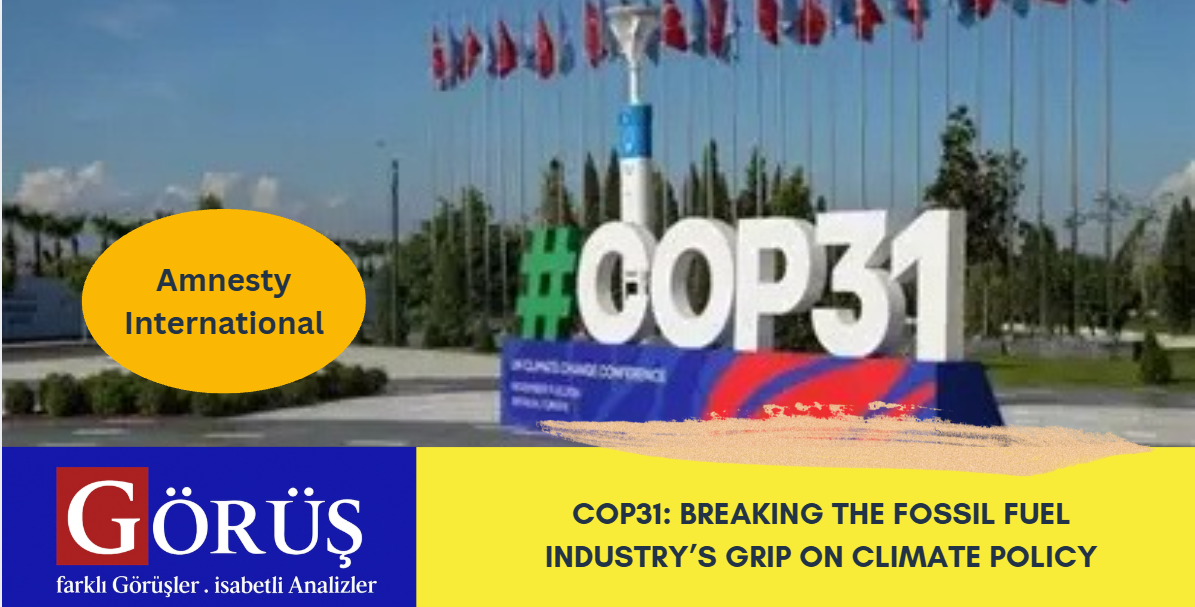
COP31: The Fossil Fuel Industry’s Grip on Climate Policy Must Be Broken
As world leaders prepare to gather in Türkiye, the climate crisis is exposing a fundamental contradiction in global politics: governments acknowledge the urgency of climate action while continuing to support the economic and political structures that perpetuate fossil fuel dependence.
The climate crisis is no longer a question of scientific knowledge. It is a question of political will.
More than three decades of international climate negotiations have produced ambitious declarations, successive commitments and repeated promises of action. Yet global greenhouse gas emissions remain a serious challenge, and the distance between political commitments and the measures required to address the climate crisis continues to raise fundamental questions about the credibility of international climate governance.
As preparations for the 31st United Nations Climate Change Conference (COP31) in Türkiye move forward, Amnesty International is calling on world leaders to confront one of the central obstacles to meaningful climate action: the continuing influence of the fossil fuel industry over political decision-making.
The organisation argues that governments must move beyond symbolic commitments and implement a rapid, equitable and adequately financed transition away from fossil fuels. This transition, it maintains, is not merely an environmental necessity but also an obligation grounded in human rights and international law.
The underlying problem is increasingly difficult to ignore. Governments acknowledge the dangers of global warming, yet many continue to support economic models heavily dependent on coal, oil and natural gas. The result is a persistent contradiction between declared climate ambitions and actual political and economic priorities.
As Marta Schaaf, Amnesty International's Programme Director for Climate, Economic and Social Justice, and Corporate Accountability, argues, the climate crisis is not a failure of knowledge but a failure of political courage.
That assessment raises a fundamental question for COP31: can international climate diplomacy overcome the economic interests that continue to obstruct meaningful progress?
The 1.5°C threshold and the growing cost of political delay
The latest assessment by the United Nations Environment Programme (UNEP), highlighted by Amnesty International ahead of COP31, warns that the world is on course to exceed the 1.5°C warming threshold established as a central objective of the Paris Agreement.
The consequences are already visible in increasingly destructive climate-related events, including droughts, wildfires, severe storms, floods, melting glaciers and rising sea levels.
The consequences, however, are not distributed equally. Communities with limited economic resources and inadequate infrastructure are frequently among those most exposed to climate-related disasters, despite having contributed comparatively little to the accumulation of greenhouse gas emissions.
Exceeding the 1.5°C threshold would not simply represent a statistical failure of international climate policy. It would increase the risks of irreversible environmental damage, ecosystem disruption and further violations of fundamental human rights.
Amnesty International therefore insists that the prospect of temporarily exceeding 1.5°C must not become an excuse for political resignation or further postponement.
Even if an overshoot becomes unavoidable, governments must limit its scale and duration and pursue measures capable of bringing global temperatures back down.
This distinction is important. Climate policy cannot be reduced to whether a particular temperature threshold is crossed. The duration and magnitude of warming also matter, as do the consequences for ecosystems, human settlements and future generations.
Every additional fraction of a degree carries consequences. Every year of delayed action makes the challenge more difficult.
Climate justice: Those least responsible often pay the highest price
The climate crisis is global, but responsibility for its causes and exposure to its consequences are profoundly unequal.
The devastating floods in Nepal and Tibet, following a partial collapse of a Himalayan glacier, illustrate the vulnerability of communities facing environmental threats with limited financial and institutional resources.
Such events also highlight a central contradiction in international climate politics: countries and populations that have contributed least to historical greenhouse gas emissions often face some of the most severe consequences.
For this reason, climate action cannot be separated from questions of international economic justice.
High-income countries with the greatest historical responsibility for greenhouse gas emissions must assume a substantially greater financial responsibility for supporting lower-income countries.
According to Amnesty International, this requires a significant expansion of grant-based climate finance, rather than placing additional debt burdens on countries already struggling with economic and environmental vulnerabilities.
The organisation also calls for greater financial contributions from fossil fuel corporations, their financial backers and the wealthiest segments of society, including through higher taxation.
These resources are essential for supporting emissions reductions, climate adaptation, resilient infrastructure and the transition towards sustainable energy systems.
The issue of Loss and Damage is particularly important. Countries and communities already experiencing severe climate-related destruction need financial support that recognises the consequences of a crisis they did not create to the same extent as the world's largest historical emitters.
Climate justice, therefore, requires more than encouraging developing countries to adopt cleaner technologies. It requires a fair distribution of responsibilities, resources and transition costs.
Türkiye and Australia: A test of climate leadership
COP31 places particular responsibility on Türkiye and Australia, which Amnesty International identifies as countries with important roles in hosting and leading the negotiations.
Both countries face questions about the consistency between their climate commitments and their continued dependence on fossil fuels.
Türkiye remains heavily dependent on coal while planning to expand fossil gas production. Australia, meanwhile, is among the world's largest exporters of coal and liquefied natural gas.
This creates an uncomfortable political contradiction.
A country cannot credibly present itself as a leader in international climate negotiations while pursuing policies that prolong dependence on fossil fuels for decades.
The challenge facing Türkiye is particularly significant. Hosting COP31 provides an opportunity to demonstrate that the country can contribute to a meaningful international climate framework. But this opportunity also brings increased scrutiny of its domestic energy policies.
For Australia, the challenge is equally substantial: reconciling its influential position in climate diplomacy with its continuing role in global fossil fuel exports.
The question is not whether these countries can participate in international climate negotiations. It is whether they are prepared to translate their diplomatic responsibilities into concrete domestic and international commitments.
Climate leadership must be measured by political decisions and measurable outcomes, not by declarations.
The influence of corporate interests over climate negotiations
One of the most politically sensitive dimensions of the climate debate concerns the influence of fossil fuel corporations over public policy.
The transition away from fossil fuels inevitably challenges established economic interests, investment structures and political relationships. These interests have considerable resources and influence, creating the risk that international climate negotiations may be weakened by competing commercial priorities.
Amnesty International argues that COP31 must establish a robust accountability framework capable of addressing conflicts of interest and preventing undue fossil fuel industry influence over negotiations.
This issue goes beyond the environmental responsibilities of individual corporations. It concerns the integrity of democratic decision-making itself.
When private economic interests acquire disproportionate influence over public policy, the ability of governments to act in the broader public interest can be compromised.
The transition to renewable energy must therefore be accompanied by institutional safeguards, transparent decision-making and meaningful public accountability.
Another emerging challenge is the growing energy demand associated with digital infrastructure, particularly artificial intelligence data centres. Electrification and technological development must not create new forms of fossil fuel dependence or reproduce the environmental and social problems that the energy transition is supposed to overcome.
A genuinely sustainable transition requires more than replacing one energy technology with another. It demands a fundamental reassessment of how energy is produced, distributed and consumed.
The people defending the environment must have a voice
Climate negotiations are frequently dominated by governments, international institutions and corporate representatives. Yet those most directly affected by environmental destruction do not always have an adequate voice in the decisions shaping their futures.
Indigenous Peoples, environmental human rights defenders and local communities are often at the forefront of resistance against destructive projects threatening forests, rivers, ancestral lands and livelihoods.
Amnesty International has documented grassroots climate movements in countries including Australia, Brazil, Canada, Ecuador and Türkiye.
These movements are essential to a just transition. Nevertheless, environmental defenders frequently face intimidation, criminalisation and reprisals.
The contradiction is striking: people defending ecosystems and communities are sometimes treated as obstacles to economic development, while the interests behind environmentally destructive projects enjoy considerably greater access to political decision-makers.
COP31 should challenge this imbalance.
Affected communities must participate meaningfully in climate decision-making. Their experiences and knowledge should inform policies rather than merely being acknowledged in diplomatic declarations.
Amnesty International also calls for the implementation of the Gender Action Plan, including stronger protection for women environmental defenders, and for the second Global Stocktake to be firmly rooted in human rights and shaped by affected communities.
The proposed Global People's Assemblies represent another opportunity to strengthen public participation in international climate governance.
Climate justice requires civic freedom
There can be no meaningful climate justice without the freedom to demand it.
For Türkiye, hosting COP31 also brings responsibilities concerning freedom of expression, peaceful assembly and the protection of civil society.
Amnesty International stresses that everyone participating in the conference must be able to do so safely and freely, without discrimination, intimidation or reprisals.
Environmental activists, human rights defenders and other civil society representatives must be able to express criticism, organise peaceful protests and challenge government policies.
This is particularly important for groups facing intersecting forms of discrimination, including LGBTI+ people and environmental defenders.
International climate conferences should not become spaces in which public criticism is tolerated only when it remains politically convenient.
The credibility of COP31 will depend not only on the agreements reached behind closed doors but also on whether governments allow the public to scrutinise, question and challenge those decisions.
Climate policy is ultimately about people's lives and futures. Those affected by it must have the freedom to participate in shaping it.
COP31: Another declaration or a turning point?
The central challenge facing COP31 is not a lack of scientific evidence, technical knowledge or policy proposals. It is the political difficulty of confronting powerful economic interests and translating international commitments into enforceable action.
Amnesty International has identified several priorities, including a strong Belém–Antalya Mechanism for Just Transition, increased climate finance, adequate replenishment of the Loss and Damage Fund, stronger protection for environmental defenders and reforms to international climate governance.
It also calls for a full, fast, fair and funded phase-out of fossil fuels, taking account of the different responsibilities and capacities of countries.
These proposals form an important contribution to the debate. Their implementation, however, will ultimately depend on political decisions made by governments and the willingness of the international community to hold them accountable.
The energy transition cannot succeed if its economic costs are transferred disproportionately to poorer societies, workers and vulnerable communities. Nor can it succeed if the political influence of the industries responsible for the problem continues to shape the pace and direction of the solution.
COP31 therefore represents more than another diplomatic gathering. It is an opportunity to confront the structural contradictions that have limited international climate action for decades.
The real measure of success will not be the number of declarations adopted or the promises made before international audiences.
It will be whether governments are prepared to challenge established interests, finance a genuinely just transition, protect environmental defenders and accept their responsibilities towards present and future generations.
The world does not need another generation of climate promises. It needs political decisions that finally match the urgency of the crisis.
Editorial note: This article draws on Amnesty International's recommendations and public statements ahead of COP31. The policy assessments and demands attributed to the organisation represent its position and should not be interpreted as adopted COP31 decisions or as the institutional position of GörüşDergisi.
Source:
Amnesty International,
COP31: World leaders must break fossil fuels' grip on climate policy and people's futures.
COP31_World leaders must break fossil fuels' grip on climate policy and people’s futures..docx

Okur Yorumları (0)
Henüz yorum yok. İlk yorumu siz yazın.