

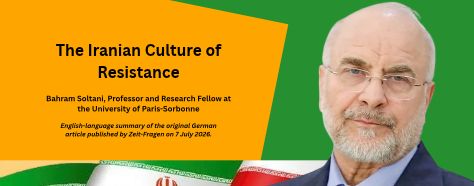
An Analysis of the Historical and Geopolitical Dimensions of the American and Israeli War Against Iran
Author: Bahram Soltani, Professor and Research Fellow at the University of Paris-Sorbonne
English-language summary of the original German article published by Zeit-Fragen on 7 July 2026.
The following summary presents the author's principal arguments and conclusions. It is not a complete translation, and the author's interpretations should be distinguished from independently established historical facts.
1. Iran's Historical and Cultural Resilience
Bahram Soltani argues that the military confrontation between the United States, Israel and Iran has revealed important historical, political and cultural dimensions of Iranian society. In his view, Iran's capacity to withstand external pressure cannot be explained solely by its military capabilities or the policies of the Islamic Republic.
The author emphasizes the Iranian population's attachment to its national identity, arguing that this connection is frequently misunderstood or oversimplified in Western political discourse.
He also acknowledges that Iranian society faces significant internal challenges, including economic hardship, social restrictions and political tensions. According to Soltani, the resilience demonstrated during the conflict should therefore encourage the Iranian leadership to address citizens' demands more seriously.
He proposes a renewed social and political compact between the state and the population, grounded in shared historical, cultural and religious traditions. Greater participation by workers, teachers, students, academics, healthcare professionals, intellectuals, businesspeople and farmers in political decision-making could, he argues, strengthen national cohesion and institutional stability.
2. Iran's Historical Experience of Foreign Intervention
Soltani places Iran's contemporary political outlook within the context of its long history of foreign intervention.
One of the central historical events discussed is the 1953 coup against Iranian Prime Minister Mohammad Mossadegh.
Following the nationalization of Iran's oil industry in 1951, Mossadegh's government became embroiled in a confrontation with British interests. In August 1953, a coup organized with the involvement of British and American intelligence agencies overthrew his government.
The author interprets this episode as a defining moment in Iran's modern political consciousness. In his account, the overthrow of Mossadegh strengthened the Shah's position and contributed to the historical circumstances that eventually culminated in the Iranian Revolution of 1979.
Soltani also argues that Mossadegh's resistance to foreign pressure inspired nationalist movements elsewhere, particularly in Egypt and Algeria.
For the author, the historical significance of 1953 extends beyond Iran: it illustrates how external intervention can shape a country's political development and leave lasting consequences for its relationship with Western powers.
3. Military, Economic and Political Pressure Since 1979
The article examines the pressures Iran has faced since the Islamic Revolution.
Soltani highlights the Iran–Iraq War of 1980–1988, the extensive international tensions surrounding Iran's political system, and the economic sanctions imposed on the country over several decades.
He argues that these measures have imposed substantial costs on Iranian society, particularly on ordinary citizens. In his assessment, sanctions have frequently failed to achieve their stated political objectives while contributing to economic and social hardship.
The author also questions the legal basis of unilateral sanctions, particularly when they affect third countries, international organizations or private actors beyond the sanctioning state's jurisdiction.
He presents such measures as a form of sustained economic warfare and argues that they raise fundamental questions about national sovereignty and the international legal order.
These conclusions represent the author's interpretation of sanctions and international law. The legality of particular sanctions depends on their legal basis, design and circumstances; sanctions are not all governed by identical legal rules.
4. Targeted Killings and International Law
Another major theme is the use of targeted killings in the strategies pursued by the United States and Israel.
Soltani argues that the targeting of political leaders, scientists and military personnel, including incidents involving civilian family members, threatens established principles of international law.
He is particularly concerned about the normalization of extrajudicial killings and their implications for the international system developed after the Second World War.
In his view, such practices weaken the principles of state sovereignty and the legal restraints intended to govern the use of force.
The broader question raised by this section is how international law can retain its credibility when powerful states employ methods whose legality is disputed or whose application appears inconsistent.
5. The International Atomic Energy Agency and the Question of Double Standards
Soltani also examines the role of the International Atomic Energy Agency (IAEA) and the international nuclear non-proliferation framework.
He contrasts Iran's position as a party to the Treaty on the Non-Proliferation of Nuclear Weapons (NPT) with Israel's position outside the treaty.
Iran's nuclear programme has been subject to international safeguards and inspections, although the scope and implementation of monitoring arrangements have varied over time. Israel, which is widely understood to possess nuclear weapons, is not subject to the same NPT obligations as a non-nuclear-weapon state party.
The author argues that this difference contributes to perceptions of a double standard in the international nuclear order.
In his assessment, the unequal application of international scrutiny undermines the credibility and legitimacy of the non-proliferation system.
His argument raises a broader question: can an international legal framework maintain public confidence when countries face different obligations and levels of scrutiny?
6. The Cultural Foundations of Iranian Resistance
The article's central argument is that Iranian resilience has deeper roots than military preparedness or political ideology.
Soltani identifies several elements of Iran's cultural heritage as important sources of collective identity:
- Language and literature: Persian provides a common cultural reference point across generations.
- Poetry and philosophy: Figures such as Ferdowsi, Hafez, Rumi, Saadi and Omar Khayyam remain influential in the cultural imagination.
- Historical memory: Experiences of foreign intervention have contributed to a lasting sensitivity toward questions of independence and sovereignty.
- Religious traditions: Shiite Islam and its emphasis on sacrifice are presented as important elements of the country's cultural and political consciousness.
The author also refers to Montesquieu's Persian Letters, published in 1721, as an example of the intellectual significance of the Persian perspective in European thought.
Taken together, these traditions help explain, in Soltani's interpretation, why national solidarity can persist even amid political disagreements and social dissatisfaction.
An important distinction follows from this argument: attachment to Iran as a nation does not necessarily imply unconditional support for its government. National identity, political allegiance and approval of the existing political system are different things, even when they overlap.
7. The War Against Iran and the International Legal Order
In his concluding assessment, Soltani questions the legal and political justification for military action against Iran.
Drawing on the United Nations Charter, the Geneva Conventions and principles associated with the theory of just war, he argues that the military actions under discussion lack a convincing legal justification.
He emphasizes that the use of force must be assessed against the requirements of international law, including the prohibition on the use of force, the rules governing self-defence and the applicable laws of armed conflict.
The author further contends that the objectives pursued by the United States and Israel may extend beyond concerns about Iran's nuclear programme.
He suggests that the broader strategy could involve weakening Iran's capacity for independent action and ultimately pursuing regime change, including through attacks against military and scientific personnel.
This is the author's interpretation of the strategic objectives behind the conflict; it should not be treated as an independently established account of the intentions of the governments concerned.
Soltani concludes that Iran's ability to maintain its territorial and political integrity despite decades of external pressure demonstrates the continuing significance of national identity, historical memory and cultural resilience.
Overall Assessment
Bahram Soltani's article advances a central thesis: Iran's resistance to external pressure is rooted not only in military capabilities or the policies of its government, but also in a much older cultural identity shaped by historical experience, literature, religion and the pursuit of national independence.
Three broader arguments emerge from his analysis.
First, historical experiences of foreign intervention can influence a country's political outlook for generations. The 1953 coup remains particularly important to understanding Iranian perceptions of Western intentions.
Second, economic sanctions and military pressure raise questions about their humanitarian consequences, political effectiveness and compatibility with international law. Evaluating these questions requires distinguishing between the stated objectives of particular measures, their actual consequences and their legal justification.
Third, the legitimacy of the international order depends in part on the consistent application of its principles. Perceived double standards in nuclear non-proliferation, sovereignty and the use of force can undermine confidence in international institutions.
The article also leaves an important question open: how can Iran's demonstrated national resilience be reconciled with the legitimate social, economic and political demands of its own population?
That tension is particularly significant. A society's capacity to resist external pressure does not, by itself, establish the legitimacy of its political institutions. Equally, internal dissatisfaction does not eliminate a population's interest in national independence and protection from foreign intervention.
The most productive way to engage with Soltani's argument is therefore to examine both dimensions: the historical and legal questions surrounding external intervention, and the relationship between national sovereignty, political legitimacy and the rights of citizens.
Source: Bahram Soltani, “Die iranische Kultur des Widerstands,” Zeit-Fragen – 7 July 2026.

Okur Yorumları (0)
Henüz yorum yok. İlk yorumu siz yazın.