

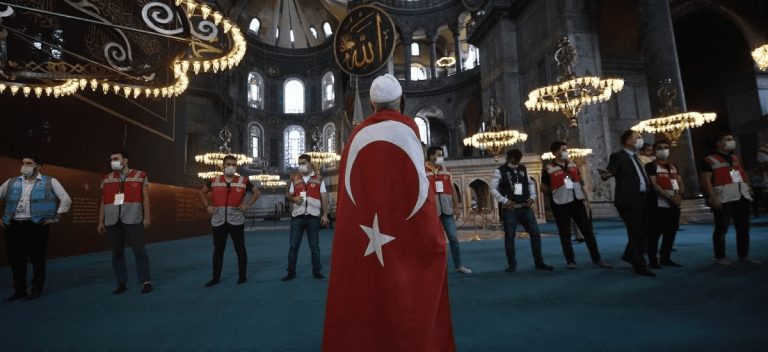
Foto: Ahvalnews.com
The rise of political Islam in Turkey is a complex and multifaceted phenomenon that has evolved over several decades. Understanding this involves looking at historical, political, and social factors. Here is a brief overview:
Historical Context:
- Turkey has a long history of secularism, dating back to the early 20th century when Mustafa Kemal Atatürk founded the modern Turkish state. Atatürk implemented a series of reforms aimed at secularizing and modernizing the country.
- However, over time, there has been a tension between the secularist establishment and more conservative, religious segments of society.
Political Landscape:
- The Justice and Development Party (AKP), led by Recep Tayyip Erdoğan, played a pivotal role in the rise of political Islam in Turkey. The party was founded in 2001 and came to power in 2002.
- The AKP presented itself as a conservative democratic party and initially focused on economic reforms. Over time, however, critics argued that it pursued policies that reflected a more Islamist agenda.
Economic Factors:
- The AKP government implemented successful economic policies, leading to improved living standards for many Turks. This contributed to the party's popularity and electoral success.
Changes in the Political Landscape:
- The AKP gradually shifted its focus towards a more conservative and Islamic agenda. This was reflected in policies related to education, social issues, and the public sector.
- There was a growing influence of religious discourse in public life, including in politics and education.
Challenges to Secularism:
- Some critics argue that the AKP's policies eroded the secular principles established by Atatürk. This led to tensions between secularists and those supporting a more Islamic-oriented political system.
Authoritarianism Concerns:
- As the AKP consolidated power, concerns emerged about the erosion of democratic institutions and increasing authoritarianism. These concerns intensified after events like the Gezi Park protests in 2013.
Foreign Policy Dynamics:
- Turkey's foreign policy under Erdoğan also shifted, and it played a more assertive role in the Middle East. This led to debates about the influence of political Islam in shaping Turkey's international relations.
Post-2016 Coup Attempt:
- The attempted coup in 2016 had a significant impact on Turkish politics. Erdoğan's government accused Fethullah Gülen, a cleric in self-imposed exile, of orchestrating the coup. Gülen's movement had previously been aligned with the AKP, but a fallout occurred, leading to a crackdown on Gülen supporters.
The rise of political Islam in Turkey is a dynamic process with ongoing developments. It involves a complex interplay of political, social, and historical factors, and perspectives on this phenomenon can vary widely depending on one's political stance and perspective within Turkish society.

Okur Yorumları (0)
Henüz yorum yok. İlk yorumu siz yazın.